Showing posts with label notion. Show all posts
Saturday, 2 April 2016
POST 14: Individual Documents on 'Spaces & Exchanges' Notion
Sunday, 13 March 2016
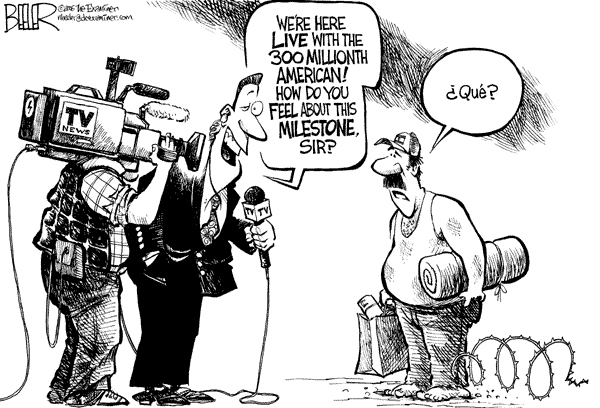
POST 11: SPACES & EXCHANGES: ¿Qué? A cartoon by Nate Beeler (2007)
Nate Beeler is the editorial cartoonist for the Columbus Dispatch. His award-winning cartoons have appeared on CNN, Fox News, and in such publications as Time, Newsweek. He is one of the most widely read editorial cartoonists, with his cartoons distributed internationally to more than 800 publications. We are going to describe and interpret a cartoon made by Beeler that illustrates immigration in the United States related to the notion of Spaces and Exchanges.
To begin with, this cartoon depicts three characters in black and white. On the left we have two reporters. First, a cameraman dressed with a plaid shirt, is carrying a huge video camera that covers his face. On it there is a sticker with the words: ‘TV NEWS’. Beside him, is represented a reporter. He is wearing a black suit with a grey tie. He is holding a microphone in one hand and has his other hand in his pocket. Smiling, he speaks to the camera and asks the third character: We’re here live with the 3000 millionth american! How do you feel about this milestone sir? These two characters are interviewing the man who is on the right. Contrary to them, he seems to be scruffy and dirty because he is wearing a cap, a white tank top, jeans and surprisingly he has no shoes. Furthermore, he has a moustache and the shirt that he wears reveals his chest hair. He is carrying a bag full of things in one hand and a sleeping bag under the other arm. Clinging to his trousers is barbed wire. He seems to be confused and does not understand the situation that is why his only answer is the Spanish question: ‘¿Qué?’ wich means ‘What?’.
It is obvious that with this cartoon, Beeler wants to criticise the treatment given to immigrants who arrive in the United States. First of all, we can deduce through the answer given by the character interviewed that he seems to be a Mexican who has just crossed the border, this is seen because of the barbed wire that usually protects borders from illegal crossing. In fact the Mexico- United States border is the most frequently crossed international boundary in the world. The illegal immigrants are called wetbacks because they have to cross the Rio Bravo that divides both countries. Moreover, with this cartoon the artist wants to point out the fact that sometimes journalists make reality up pretending something that it is not true just for the salce of the show. In addition to this, here the reporter qualifies the situation as a milestone just because the Mexican man has just arrived despite all the troubles that he must have gone through. To sum up just with a little glance at both characters we can see they belong to opposed worlds.
In relation to the notion Spaces and Exchanges this cartoon reveals a current reality: the clash of two worlds, North and South, rich and poor world. Although Beeler illustrates this scene in America this ‘illegal’ migration happens everywhere in the world and not only because of money and work but also because of wars. On the other hand those who are rich and powerful can cross the border easily. As a conclusion this cartoon evinces the idea that with new technologies huge amounts of people are able to see what is happening around the world but just a few react.
Labels:
bac,
cartoon,
natebeeler,
notion,
spaces and exchanges
Sunday, 29 November 2015
POST 7: 'Pop Art Myths' and the 'MYTHS & HEROES' Notion
First of all, to illustrate the notion of Myths and Heroes, it is important to comprehend the ideas of ‘myth’ and ‘hero’. On the one hand, a myth can be defined as a popular belief or story that has become associated with a person, institution, or occurrence, especially one considered to illustrate a cultural ideal. On the other hand, a hero is a man of distinguished courage or ability, admired for his brave deeds and noble qualities.
This notion can be linked to the Pop Art movement, which emerged in the late 50's and early 60's. It is one of the most liberating moments in the history of art. Breaking the rules of classic art, endorses the new culture of technology and consumerism by representing every manner of objects from visual and popular culture. Every object can become art, that is why this movement brings and end to the division between 'high' and 'low' culture. It includes different styles of painting and sculpture from various countries.
And now the question is… What is the relationship between these two concepts?
To answer this question, I have chosen a painting entitled ‘Las Meninas’ by the artists ‘Equipo Crónica’ in 1970. It is an acrylic on canvas that measures 200x200 cm and we can find it today in the museum ‘Fundación Juan March’ in Palma de Mallorca.
‘Equipo Crónica’ is a valencian duo composed by Rafael Solbes and Manuel Valdés. Their paintings interpret, analyse and de-codify Velázquez’s work. Also, it belongs to the topic ‘Art about art’ where Pop art artists wonder about the evolution of art.
These are the reasons that describe why Las Meninas of Equipo Crónica are connecting to the notion ‘Myths and Heroes’…
First of all, the painting in which Equipo Crónica are inspired from Las Meninas (Spanish for the Maids of Honor) by Diego Velazquez on 1656.
The Spanish painter Velázquez (1599-1660) became renowned for his realistic portraits as a member of King Philip IV’s court. Velazquez’s technique of painting was inspired by Baroque. Baroque is the period and the style that used exaggerated motion in order to produce drama and tension in sculpture, painting, literature, dance, and music. The painting is a portrait of Infanta Margarita, the daughter of King Philip IV, and his second wife Mariana of Austria.
To sum up, the painting's complex and enigmatic composition is an excellent example of how great works of art are made. That’s why we can argue that Velazquez because of his distinguished and personal techniques, is a kind of hero or a myth of painting, that made a unique and unrepeatable work.
An important aspect of Velazquez's work is the Droste effect. That are repeated by Equipo Crónica. The Droste effect (known as mise en abîme in French) is the reflect of a picture appearing within itself, in a place where a similar picture would realistically be expected to appear.
Las Meninas allows the spectator to freely interact with the painting’s various points of view and therefore offers an example of the Droste effect.
Firstly, on the left we see a self portrait of Velazquez painting. On the center of the painting, Infanta Margarita has dropped in to see Velazquez at work. She stops right next to him, at the center of the foreground of the painting, but she seems perplexed. Finally we see a portrait of the royal family reflected in a mirror on the background.
All things considered, we can say that this innovative technique of the Droste effect made by Velazquez it is a well known fact that confirmed the idea of Velázquez as a mythical painter.
Moreover, Las Meninas from Equipo Crónica is a representation of a mythical painting that reuses the droste effect by representing the same characters from Velazquez’s painting and adding some details that give a modern view to the painting. In this way we can see the self portrait on the background of the valencian artists with appearing as like a ball and a float... Definitely, we can link the painting to the Myths and Heroes notion because it is a representation of a mythical painting with very accurate techniques. However, we can also relate the painting with the other notion ‘the idea of progress’ because of the alteration of the traditional home with the appearance of new technologies like the TV set, lamps...
As a conclusion, I would say that Equipo Crónica reuses Velazquez’s techniques and characters from his painting Las Meninas. Yet, it seems to me that what they really do is to represent a photo of an ordinary modern family at home. They are seeing just before going to the beach.
Personally, I like the painting and I think it is innovative and humorous to give this new look to a mythical painting like the Velazquez’s one. Nevertheless, to put it differently I think this painting is transgressive because instead of localising the painting in the king’s home, Equipo Crónica depicted the family in the living room and instead of representing the shelves with books they choose to put there the TV set. So, it is maybe a denunciation of the culture in today’s society or a denunciation about how the royal family represents. They are supposed to be learned, educated that is why they guide the country but, they are just a family like whatever family at home. That’s why I am convinced that this painting would not appeal to everyone.
Besides, Las Meninas is a mythical painting from Spanish culture and more specifically from baroques techniques that’s why a lot of artists homage the painting with their versions of it.
Picasso’s recreation of Las Meninas (1957)
Picasso made a cubism version from the original painting of Velázquez.
Dali’s recreation of Las Meninas 1975
Dali made a surrealistic version and what is interesting from his painting is the exchanging of the characters for numbers.
Mingote’s version for Las Meninas made on 2003
Mingote was an spanish cartoonist that drew daily cartoons on the newspapers. This humoristic representation embodied his style without leaving the original Velazquez painting, though one of the main characters, the infant is flying over the retinue

Saturday, 21 November 2015
POP ART MYTHS
Pop Art is an art movement that emerged in the late 50's and early 60's. It is one of the most liberating moments in the history of art. Breaking the rules of classic art endorses the new culture of technology and consumerism by representing every manner of objects from visual and popular culture. Every object can become art, that is why this movement brings and end to the division between 'high' and 'low' culture. It includes different styles of painting and sculpture from various countries. This post recaps the various themes of this movement.
Collage Advertising Comics
Pop art acquires the tradition of the collage from cubism and dadaism but it adds a subversive and allegorical component. This new tendency, turned comic strips into large-format paintings.
The precursors of this art were Richard Hamilton and Eduardo Paolozzi, members of the independent Group in London, along with works by the American Ray Johnson. In addition to this, Roy Lichtestein pop first painting is an embodiment of Pop Art definition that conceals a paradox between classic art and modern art. It certainly appears to be an enlarged panel from a comic book, but it is also a Pop version of the myth of Narcissus.
Finally, Andy Warhol was also a member of this new way of painting with his Mickey Mouse propagandistic representation.
| Roy Lichtestein, Look Mickey, 1961 |
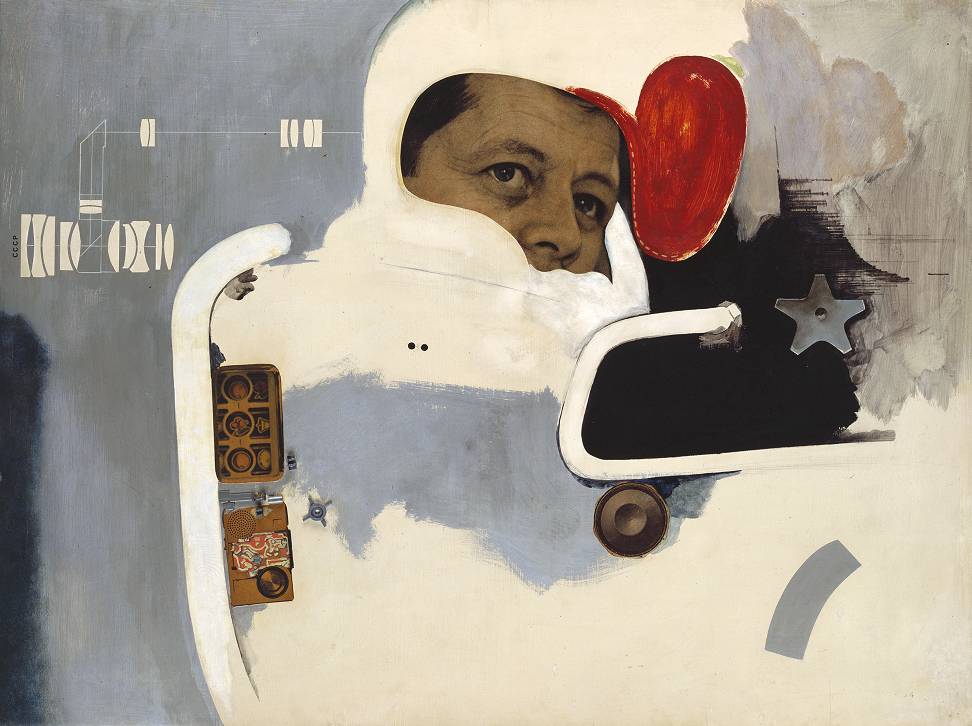
| Richard Hamilton, Together let us explore the stars 1962 |
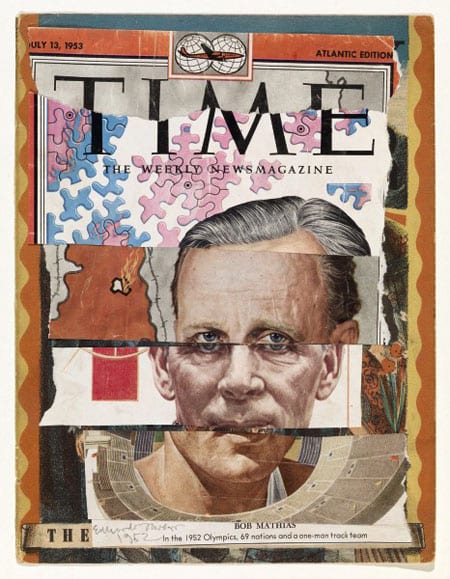
| Eduardo Paolozzi, One Man Track Team 1953 |
Emblems
It is a well known fact that in the mid-20th, advertising slogans, the brand names and logos for consumer products had inundated society and were publicized non stop in the press, radio and television... Predictably, they provided a torrent of visual ideas for Pop artists.
For instance, Jasper Johns, appropiated several universally recognize objects such as a bullseye target , as did Peter Blake some time afterwards. Warhol began to represent certain everyday objects repeatdly including logos and trademarks like ‘Green Stamp’ loyalty coupons, Cambell’s soup cans, Brillo soup pads, Heiz ketchup and Coca-Cola. Robert Indiana turned a series of different words like ‘eat’, ‘hug’ and ‘err’ into emblems which he stenciled onto various supports.
| Andy Warhol, Coca Cola 210 bottles 1962 |
| Andy Warhol, Heinz Tomato Ketchup box, 1964 |
| Robert Indiana, love 1966 |
Myths
During this golden era, the film industry also grew strongly. Hollywood became a myth-making machine: Marilyn Monroe, Elizabeth Taylor, Marlon Brando, James Dean… Those actors who archieved success in the Dream factory immediatly became idols for the general public and many of them are featured in the work of Pop art artists.
Alex Katz was one of the first that portrayed famous people. Warhol immortalized Marilyn Monroe transforming her into object of veneration. Moreover, Mimmo Rotella transfigured Elizabeth Taylor, in her role as the queen of Nile in a majestic décollage of the poster of the film Cleopatra. In short, British Pop artists were able to combine the media power of the great American idols with specific elements from their own popular culture.
| Andy Warhol Marylin Monroe 3x3, 1967 |
![]() |
| Alex Katz, Ted Berrigan 1967 |
| Andy Warhol, Self-portrait 1986 |
| Allen Jones, Self portrait 1981 |
Warhol marks the turning point at which the model of the portrait fades away and becomes a virtual image. In his series of self-portraits, the artist also meditates on death. Allen Jones, for his part, explores deeply the portait through the sitter .
Finally, David Hockney makes use of immediacy of Polaroids as the basis for his portraits.
| David Hockney, Kasmin 1982 |
Landscapes, Interiors, Still Lifes
| Tom Wesselmann, Still life, 1963 |
Lichteinstein’s landscapes based on Expressionism, Patrick Cauldfield’s and Valeiro Adami’s interiors are some of the examples of this reinterpretation of art.
Urban Eroticism
The middle years of the 20th century brought a transformation of social attitudes with it a new sexual freedom encouraged the spread of eroticism in every sphere of society. As a result, mass media became inundated with erotic metaphors featuring seductive women and attractive men. This immediately, influenced Pop Art representations.
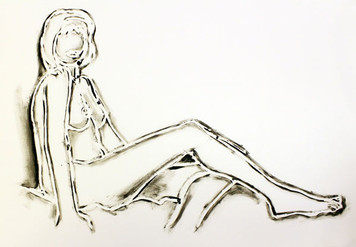
The voluptous women of Richard Lindner and Allen Jones have the quality of erotic fetishes. James Rosenquist marked by almost photographic realism, women and automobiles alike are transformed into objects of desire. Wesselmann represented allegories of women as sexual symbol.| Tom Wesselman,Monica sitting one leg on the other 1986 |
| Richard Lidnet,Tank you 1971 |
An essential part of Pop art iconography were the Historical events and contemporany affairs. Historical paintings of Pop Art artists were inspired by the huge amount of news and images coming from the mass media.
Major historical figures like Mao Zedon, John F.Kennedy, Richard Nixon, Franco... are the protagonists of paintings that reflect this existential mass of news bringing the point of view of Warhol,Rotella,Richter, Juan Genovés...
Art about Art
Pop art artists wonder about the evolution of art that is why an essential part of Pop art led to the subject of 'art on art'.
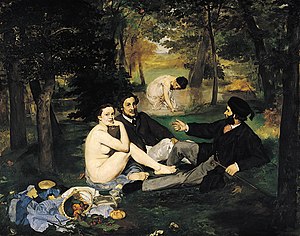
For instance Warhol creates new versions of Boticelli using photographs, Hockney ruminates on Rennaissance art, Alain Jacquet parodies Manet paintings...
| Alain Jacquet, déjeuner sur l'herbe 1963 |
| Manet, déjeuner sur l'herbe 1863 |
Subscribe to:
Posts (Atom)